For toddlers, the best tracing pages have thick dotted lines, a clear green start dot and a fun reason to draw, like helping a car reach its house.
Step by step
- 1Standing lines
Top to bottom, like rain falling. Say “down, down, down” as your child traces.
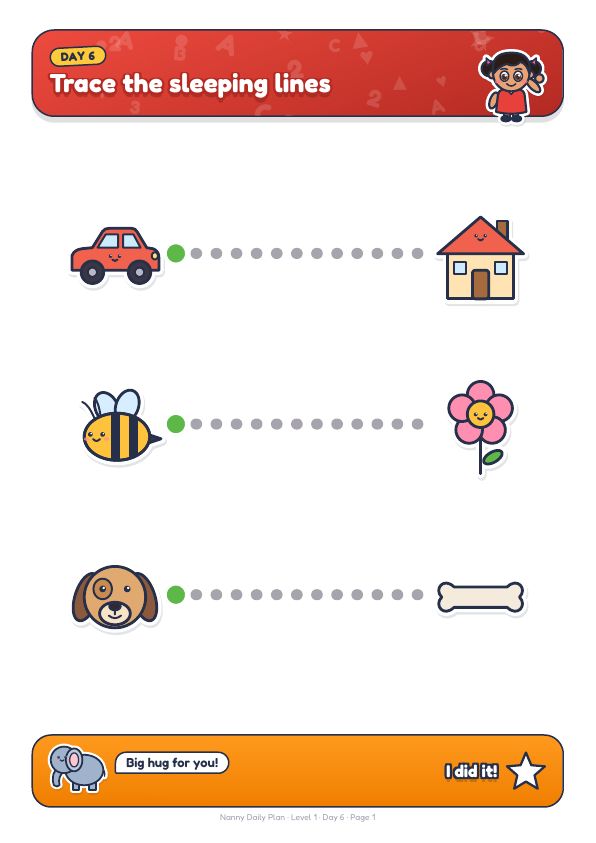
- 2Sleeping lines
Left to right, like a car driving home. This is the direction of reading and writing.
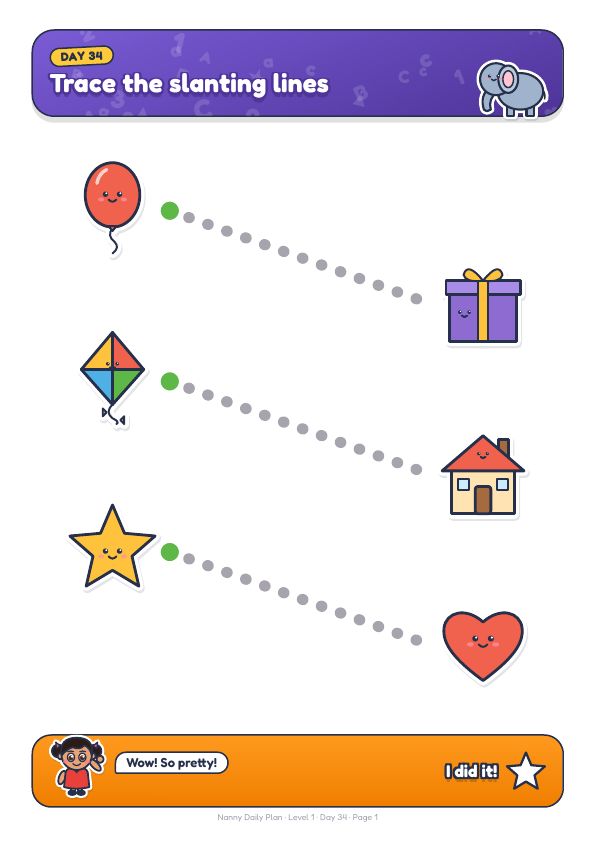
- 3Slanting lines
Like a slide in the park. Say “wheee!” and make it fun.
- 4Curves and hops
A frog jumping from leaf to leaf builds smooth, curved movements.
- 5Waves and zigzags
A duck swimming on waves, a bee buzzing in zigzags. These need more control, so save them for later.
- 6Shapes
Trace a big circle, then a square and a triangle. Always start at the green dot.
See it on paper
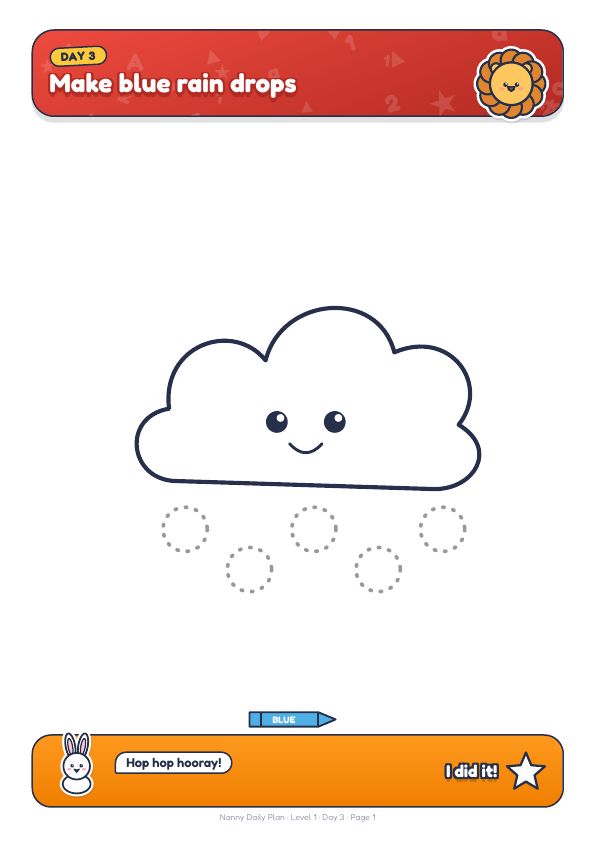
These pages come from the TAILR Daily Workbook for Kids, a 60-day printable plan for ages 1–3.
Tips for parents and nannies
- Finger first, crayon second. Let your child trace with a finger before using a crayon.
- Chunky crayons are easier to hold than thin pencils at this age.
- It is fine if lines are wobbly. Effort matters more than neatness.
Questions
When should a child start tracing?
Many children enjoy simple line tracing from around age 2 to 3, using a finger or a chunky crayon.
Which lines should a toddler trace first?
Standing lines (top to bottom) and sleeping lines (left to right) are the easiest to begin with.
How do I improve my toddler’s pencil grip?
Tearing paper, picking up small safe objects, playdough and finger painting all build the small muscles needed for grip.